
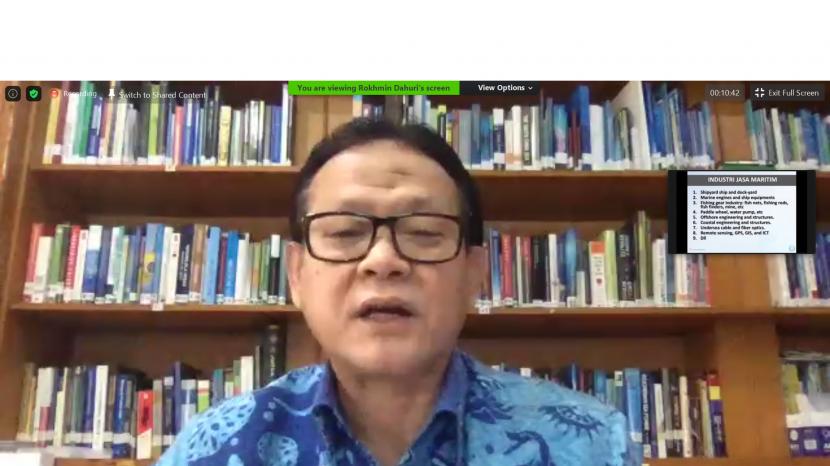
REPUBLIKA.CO.ID, JAKARTA - Professor of the Faculty of Fisheries and Marine Sciences-IPB University, Prof. Dr. Ir Rokhmin Dahuri MS said, actually development policies must be made in a sustainable and tiered manner. "There are short-term, medium- and long-term developments," said Prof. Rokhmin Dahuri.
He stated this when he was a resource person for the National Political Leadership School (SKPB) Force X Akbar Tandjung Institute (ATI) entitled "Political Direction of Marine Resources" which was held online, Wednesday (30/6). However, the marine and fisheries expert assesses that the current development policy in Indonesia has not been carried out sustainably in almost all sectors, including the development of the marine sector. "Every time the government changes, the policies also change," he said.
On the other hand, he said, not a few human resources who are placed in a strategic area to carry out a policy are not in accordance with their capacity or expertise. "I remember the hadith of the Prophet Muhammad SAW, if a matter is left to someone who is not an expert, then wait for it to be destroyed. So, yes, it must be the same as the expert, as well as pious," said the former Minister of Maritime Affairs and Fisheries.
Rokhmin said that national development policies are like a poco-poco dance. "It's like the poco-poco dance, back and forth, back and forth, because of unsustainable development policies," said the general chairman of the Indonesian Aquaculture Society (MAI) in a release received by Republika.co.id. On this occasion, Rokhmin explained at length Indonesia's extraordinary potential in the marine and fisheries sector so that it is very worthy of being the world's maritime axis.
First, Indonesia as the largest archipelagic country in the world with 99 thousand km of coastline (second longest in the world) and 75 percent of its territory is in the form of sea, which contains economic potential - natural resources (SDA) and environmental services (Jasling) - very large and not yet fully developed. optimally utilized. Second, the human need for natural resources and Jasling continues to increase. "Meanwhile, the existing natural resources and Jasling on the mainland are running low or difficult to develop," he said.
Third, marine economic sectors (such as aquaculture, capture fisheries, fishery product processing industry, marine biotechnology industry, ESDM and marine tourism) are very profitable, absorb a lot of labor, produce a wide multiplier effect, generally located in rural and outside areas. Java (reducing development disparities between regions), most people can do it, and it is sustainable (sustainable).
He said the total economic potential of Indonesia's 11 marine sectors reached US$1.348 trillion/year, or seven times the 2021 APBN (Rp. 2,750 trillion = US$196 billion) or 1.2 of the 2020 National Gross Domestic Product (GDP).
Then, the marine sector provides employment for 45 million people or 40 percent of the total Indonesian workforce.
Meanwhile, in 2018, the contribution of the marine economy to Indonesia's GDP was around 10.4 percent. "Other countries with smaller marine potential (such as Thailand, South Korea, Japan, Maldives, Norway and Iceland), the contribution is more than 30 percent," he said.
Fourth, Indonesia's geoeconomic position is very strategic, at the heart of the Global Supply Chain System, where around 45 percent of goods traded in the world with an average value of 15 trillion US dollars/year are shipped via Indonesian seas (ALKI).
fifth, Indonesia's geopolitical position is very vital, choke points between the Pacific Ocean and the Indian Ocean; and flanked by the continents of Asia and Australia. "In order for Indonesia's aspiration to become the world's maritime axis to be achieved, it is necessary to reorient the nation's development paradigm, from land-based development to marine-based development," said Prof. Dr. Ir Rokhmin Dahuri MS.
Kamis 01 Jul 2021 15:30 WIB
Red: Irwan Kelana

